The AI driven stock rally is hitting an “air pocket” as adoption of the technology has yet to catch up with the massive infrastructure spend over the past two years.
The 2026 stock market is being driven by only ten stocks, 9 of which are AI related. 60-80% of all S&P 500 earnings growth is coming from a basket of 42 AI stocks. Outside of AI related names, half of virtually every sector is in a bear market, down 20% from its highs. And now, AI driven capex spending is hitting questions over its profitability, local power grids, water systems, zoning boards, and political resistance rising faster than the revenue meant to pay for it. Questions over the safety of AI are endemic as h...
Read morePosted on 10/16/2026 at 10:01 AM


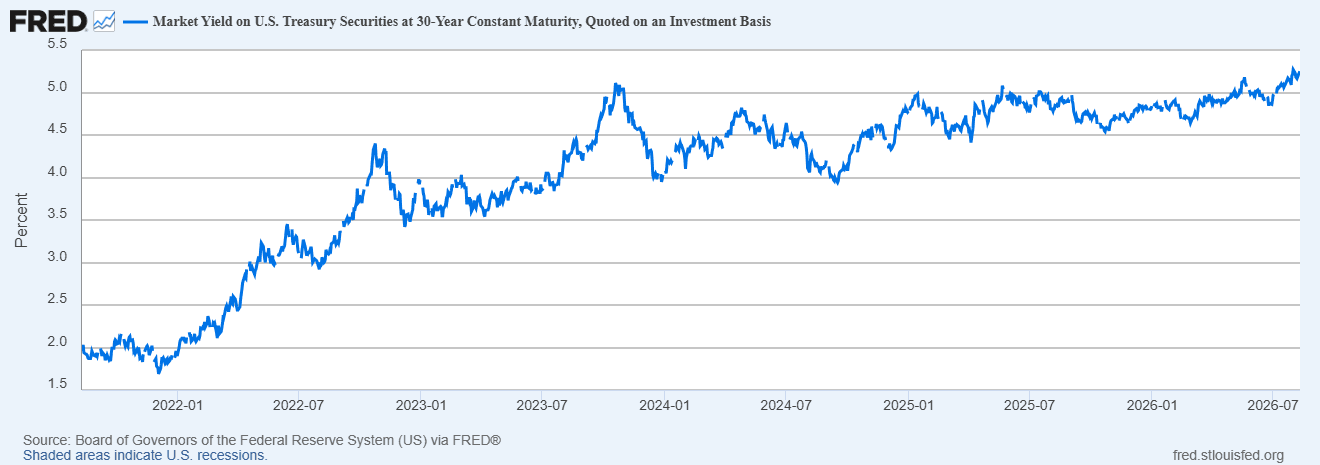
The following two charts represent the yield on 10- and 30-year U.S. treasury bonds.
Treasury bonds are used to price mortgage bonds. Thirty-year mortgage rates, around 6.8%, are still below the highs seen in 2023, meaning that the mortgage spread over treasuries has compressed substantially. But the trend in log term treasury and mortgage rates seems to be on the rise.
Today’s 30-year bond auction was somewhat weak, and demonstrated that investors are demanding substantial compensation to take on 30-year duration. The yield on the 30-year bond auction today was 5.216%.
Posted on 08/13/2026 at 11:23 AM
This quarter the topics to highlight are inflation, the Iran war, the new Fed Chair, the rotation of the AI trade, and their effects globally.
The US unemployment rate is now at 4.2%, with a jobs market “treading water” that has only added a mere 92,000 so far this year. Healthcare and Social Services are responsible for all of that job growth since January 2025; remove this sector and the job market has actually been shrinking. This may be due to a sharp decline in immigration. GDP growth in the first quarter came in at 2.1%, down from 2.5% overall last year, and is forecast to be at 1.3% in the second quarter by the Atlanta Fed.
Renewed concerns that AI spending may be peaking ha...
Read morePosted on 07/16/2026 at 09:12 AM
The Iran conflict has changed a great deal in the investment landscape, and it is difficult to imagine a return to normal in the immediate future.
Fiscal pressure on governments (particularly the US), inflation sensitivity, energy chokepoints, and credit stress is beginning to take a toll on investors’ mindsets and creating anxiety.
The AI technology revolution, which had been one important driver of the stock market last year, has been dampened by events in the Persian Gulf that have driven oil and gas prices to multi decade highs. Inflation expectations have subsequently risen dramatically. While we entered 2026 expecting three interest rate cuts and a tailwind for stocks, we now face ...
Read morePosted on 04/10/2026 at 09:16 AM
The economic outlook for 2026 is constructive, with GDP growth in the US estimated to be around 2%, and worldwide growth around 3%. Analysts expect S&P 500 earnings to grow at 15%, marking another strong year for corporate profits. Most sectors are expected to report robust earnings growth, with technology and industrials anticipated to increase by double digits, and overall corporate revenue growth at around 7%.
Stock valuations remain elevated, with the Cyclically Adjusted Price-to-Earnings Ratio (CAPE) ratio at 39, the second highest level in 150 years. As opposed to the dot-com era, current valuations are better supported in many sectors by earnings growth and business fundamentals, but t...
Read morePosted on 01/15/2026 at 05:52 PM
The U.S. Supreme Court will hear oral arguments on the legality of Trump’s sweeping global tariffs on November 5, which will prove important to markets as a test of the US Presidents use of his executive power to drive his economic agenda through the International Emergency Economic Powers Act. If the tariffs are found to be illegal, the nonpartisan Committee for a Responsible Federal Budget estimates that it will cost the US government $2.2 trillion by 2035, and push U.S. debt-to-GDP to 126 percent from their current baseline scenario of 120 percent. It should be noted that S&P, the ratings agency, recently affirmed a “stable” outlook to the U.S. credit rating because they...
Read morePosted on 10/15/2025 at 08:02 AM
,The first half was notable because the tariff chaos, due to the current administration’s trade policies, caused a 20% selloff in the stock market before Wall Street dismissed them as not to be taken seriously.
At the time of this writing, Trump tariffs continue to evolve outrageously, with diminishing impact on the stock market. The imposition of a 50% general tariff on the imports of Brazil, for example, as a punishment against the people of Brazil for their judicial treatment of former president Jair Bolsonaro, raises eyebrows considering that the U.S. has run a trade surplus with Brazil for 18 years. The sudden lack of volatility can only be explained by the fact that hard economic ...
Read morePosted on 07/15/2025 at 10:40 AM
Former Treasury Secretary Janet Yellen said this week that President Trump has taken a “wrecking ball” to the economy and could not give a “passing grade” to its handling thus far. The financial markets would agree with her. The utter chaos and uncertainty of the past two weeks make any analysis going forward difficult at best.
Because tariffs are inflationary, long term Treasury bonds have been selling off, causing long bond yields to rise worldwide. President Trump has asked the Fed to lower rates, and the Fed refuses to do so because this would fuel inflation. As consumers recoil and households feel less wealthy due to a declining stock market and higher unemploymen...
Read morePosted on 04/15/2025 at 07:11 AM
It is likely that 2025 will bring tension between the Federal Reserve and the Federal government. After last week’s strong jobs report, the possibility of further interest rate cuts has greatly diminished, and everything is pointing to higher bond yields which are rising to their highest levels since 2023. The futures market is now predicting only one interest cate cut in September. Indeed, some analysts are even beginning to consider the possibility of rate hikes in 2025, after a University of Michigan survey showed consumers’ inflation expectations jumped to 3.3% in January from 2.8% the month prior. Stocks are now back to pre-election levels.
The showdown this year will be betw...
Read morePosted on 01/15/2025 at 01:42 PM
GDP for the second quarter grew at 3%, showing no sign of a slowdown. Concurrently, there is an aggressive global monetary easing going on worldwide, as almost every central bank in the world is lowering interest rates. Money supply is expanding, financial conditions are easing, economic conditions are good, and global stocks are reaching for all-time highs. The number of advancing stocks to declining stocks, otherwise known as “breadth”, is suggesting a continuing bullish bias.
It is unusual for central banks to begin easing financial conditions when markets are at their highs, but usually a sign that expensive asset classes should continue to become more expensive. It may be arg...
Read morePosted on 10/07/2024 at 04:12 PM