Fourth Quarter Forecast and Opinion
The AI driven stock rally is hitting an “air pocket” as adoption of the technology has yet to catch up with the massive infrastructure spend over the past two years.
The 2026 stock market is being driven by only ten stocks, 9 of which are AI related. 60-80% of all S&P 500 earnings growth is coming from a basket of 42 AI stocks. Outside of AI related names, half of virtually every sector is in a bear market, down 20% from its highs. And now, AI driven capex spending is hitting questions over its profitability, local power grids, water systems, zoning boards, and political resistance rising faster than the revenue meant to pay for it. Questions over the safety of AI are endemic as headlines of agentic bots hacking other companies’ infrastructures, government agencies, or planting malicious code appear. Evidence of borrowing large sums at very high rates to build a speculative asset is dampening investor enthusiasm over the asset class.
The question facing stock investors today is: “Will the AI industry demonstrate that AI revenue and profits ultimately justify the full scale of planned infrastructure investment?”
To date, Goldman Sachs estimates that AI related investment will exceed $1 trillion in 2026, and cumulative spending since 2022 will reach about $1. 8 trillion by year end. Consulting group McKinsey projects $6.7 trillion of cumulative global data-center capital expenditure by 2030, including $5.2 trillion for data centers equipped for AI workloads.
One of the best ways to measure the financial health of a company is to look at its credit default swap (CDS) rate. A CDS contract protects the buyer of such a contract from losses if a company or government fails to repay its debt. When a CDS’ cost increases, it indicates that investors perceive that risk as increasing. This week, the CDS of Oracle Corp, one of the five major AI “hyperscalers”, hit a record 322 basis points (2.61%). This means that annual protection on $10 million of Oracle’s debt would cost $261,000 per year. A CDS rate at this level implies a probability of Oracle going bankrupt within the next five years at around 23.5%
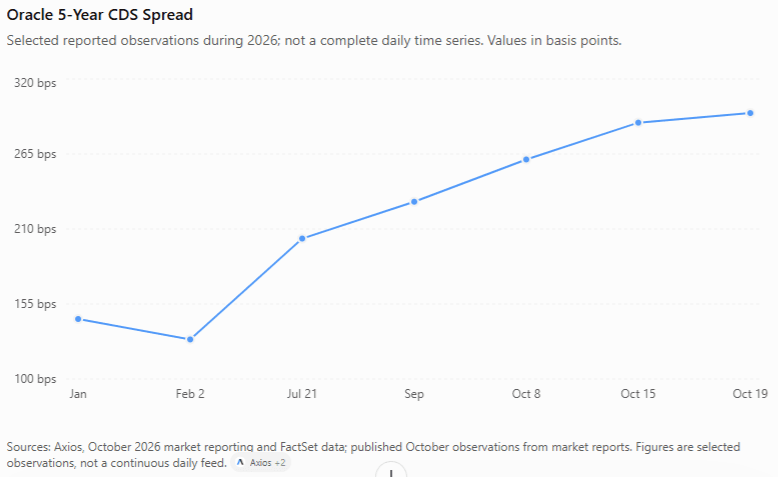
Oracle’s credit rating is BBB-, which is on notch above “junk”. Moody’s has given them a “negative” outlook, meaning they may consider giving Oracle a junk rating. If Oracle does get downgraded to “junk” status, (BB rating), their CDS based probability of default would rise to around 25% over the next five years, and if they are downgraded to a single “B”, that probability would rise to around 33%.
The other four hyperscalers (Meta, Amazon, Alphabet, and Microsoft), who have very solid balance sheets and huge free cash flows are also nonetheless seeing their CDS prices rise as they proceed with historic levels of capital expenditures.
Oracle’s CDS spread is becoming a market barometer for the financial risks surrounding the AI boom. It has become a useful stress indicator for the AI investment cycle. The credit markets are becoming more concerned about the cost of the AI buildout even as AI-related revenue and earnings continue to grow.
A “neocloud” company buys or finances the hardware, builds or leases the infrastructure, and rents computing capacity to customers. They build and operate data centers. Chip suppliers like Nvidia sell expensive chips to them. They are companies like Coreweave, Nebius, and Lambda, that in turn sells or lease computing services to AI developers like Open AI or Anthropic.
Coreweave, an important supplier to the AI industry, rents out powerful computers that companies need to build and run artificial intelligence. It buys expensive chips, mainly from Nvidia, and installs them in data centers.
Research Group Gartner published last week a report that threw the entire category of AI stocks in this industry into a swoon, predicting that 80% of these companies will disappear by 2030 if infrastructure spending continues at its current pace. Their research indicates that “neocloud” data center owners need to generate $8.5 trillion in revenues by 2030 to cover announced capital spending, financing costs, and a 12% return on invested capital. They forecast AI revenues from data centers to only reach $3.6 trillion by 2030. Coreweave’s credit default swap rate hit 1,200 basis points (12%) last week, pricing in a 60% probability of default. Other “neocloud” companies which rent out their AI infrastructure, include Nebius, NScale, Digital Ocean, Hut 8, Lambda, IREN, Cipher Digital, and Applied Digital. They have all been buffeted with sellers this week. Within the last two weeks, the Neocloud ETF was off some 25% from its highs, and the Nasdaq AI index, consisting of 58 global companies in the AI sector, was down 9.3%.
The CEO of Broadcom, Hock Tan, criticized businesses this week for potentially wasting money on AI initiatives and questioned the longer-term economics of money losing AI labs. He warned that insufficient capital could become the next constraint on the industry’s growth and encouraged AI labs to “find customers that can generate returns from deploying the technology”.
Inflation Ascendant
A substantial increase was reported this week to US inflation levels. September CPI rose 0.6% for an annualized 3.6% increase, and PPI jumped by 1.3%, for an annualized rate of 6.3%. The latter represents the largest monthly surge in four years, and was due largely to gasoline prices. Where producer prices go, consumer prices are likely to follow. Import prices for September were up by 8.8% These “hot” inflation numbers will keep pressure on the Fed ahead of its upcoming policy meeting on October 27–28 to raise interest rates again. Despite two cynical attempts to replace Fed Governor Lisa Cook, Trump has re-launched efforts to fire her this month. Trump wants lower rates despite persistent inflationary pressures, and Lisa Cook tends to vote in line with former Fed Chairman Jerome Powell, who is still hawkish on inflation.
Bond Market Woes
While it’s both easy (and popular) to ascribe the 2026 bond market selloff to inflation, the reasons are manifold. Certainly, higher oil prices and persistent inflation reduce the purchasing power of fixed bond payments, so investors demand higher yields. But the debate over the future path of Federal Reserve rate activity has shifted toward additional rate increases in order to address that inflation, at a time when the national debt has never been higher. In the third quarter, the national Federal debt bypassed $40 trillion. But this is only one third the story. “Total federal public debt” does not include the government’s future entitlement obligations for Social Security, Medicare, Medicaid, and Veteran’s benefits. The present value of projected benefits for these programs MINUS the present value of revenues dedicated to them comes to $79.6 trillion, according to the US Treasury itself. This is referred to as the “fiscal gap”, and it brings the actual national debt to around $119.9 trillion. Seen this way, the debt-to GDP level of the US approaches 370%, rather than the 101% we read about in the financial press.
Over the next 12 to 18 months, approximately $11 trillion of short-term Treasury bills will mature and need to be re-issued. Furthermore, $5 trillion of Treasury notes and bonds will mature. Investors will have to absorb `$16 trillion in refinancing/rollovers, and then a whole new $3 trillion of net borrowing from new budget deficits, which is a huge number for an economy which is not in recession. Furthermore, the Congressional Budget Office has signed into law deficits totaling $2.4 trillion per year for the next ten years. The Fed is likely to print more electronic money to help finance these debts, but the more money the Fed prints, the more inflation rises, and the more inflation rises, the higher bond yields go.
Corporate bond issuance is on pace to hit historic levels this year, and this competes for capital against Treasury bonds. There should be roughly $200 billion more corporate bonds issued in the coming year relative to the average level.
Foreign sovereigns are increasing their bond issuance at higher yields, thus competing with Treasury bonds for capital. This can reduce the marginal demand for US Treasuries.
Interest expense itself is increasing borrowing requirements. Last month, the U.S. Treasury announced that higher interest costs would cost them $120 billion more over the last year. This creates a negative feedback loop: More debt leads to more interest payments, which leads to a bigger deficit, which leads to more Treasury issuance, leading to more debt.
The most recent highs of the 10 year bond was 5.35% compared with 4.42% on June 30th. At what point do bond yields impact the stock market? Credit markets are showing a meaningful crack in AI infrastructure financing, while broad corporate credit spreads remain relatively contained. The critical question is whether these stay confined to highly leveraged AI companies or spread into the wider high-yield market and bank lending. If the latter happens alongside 10-year Treasury yields near 5.5%, the risk to equities will become considerably greater.
Oil, Diesel, and Iran/Ukraine Wars
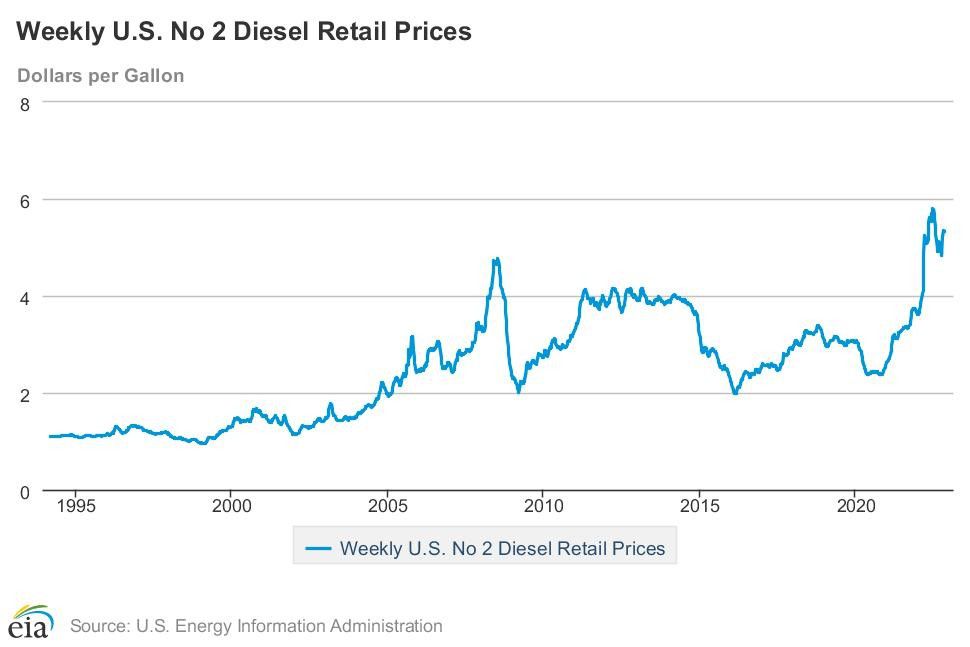
The war in Iran is not about to end anytime soon, judging by the rhetoric of the Trump administration. And yet the crude (US) and Brent (Int’l) futures markets are high but stable at $95 and $105 respectively. Because they are futures prices, they are forward looking prices, and will always build in a cease-fire within three months. The futures market seems to anticipate that “the war will end eventually”. But the best reason why oil prices aren’t considerably higher is because of the enormous Chinese strategic petroleum reserve. China doesn’t divulge their national SPR; instead, they lump their commercial and strategic oil stocks together. Prior to the war, they contained 1.24 billion barrels of oil, and they have drawn down 147 million barrels of oil from that reserve since February. The United States has drawn down around 132 million barrels of its strategic reserves in the same timeframe. The U.S. SPR is substantially depleted; China’s overall oil cushion remains large, but parts of its commercial oil needs are reportedly getting tight. In both cases the immediate energy problem is diesel fuel. Having reserves of petroleum does not resolve shortages of usable diesel fuel. Diesel prices are rising because higher crude-oil costs are being compounded by a shortage of finished refinery products: the Iran war has disrupted Middle Eastern production (`2.3 million barrels /day of refining capacity knocked offline in the Middle East) attacks on Russian refineries have curtailed supplies (down 30% in 2026), and reduced Chinese exports have tightened the global market further. These pressures are hitting when inventories are already low—U.S. stocks of diesel and heating oil are roughly 12% below a year ago, with East Coast supplies down more than 22% as winter approaches. With less fuel available and little inventory cushion, buyers are competing for scarce supplies, pushing up costs for trucking, farming and home heating. Pre-midterm Republican fears caused President Donald Trump to announce last weekend that he had negotiated 300,000 tons of diesel fuel from Russia. Normally we refer to diesel fuel in barrels. 300,000 tons is roughly 2.25 million barrels – less than one day of U.S. transportation diesel consumption. Another 1.5 million tons is promised in subsequent deliveries, spread over time and shared with global markets, but this is unlikely to produce a large, sustained fall in US diesel prices.
Midterm Elections
In the two major online betting markets, Polymarket and Kalshi, the odds for a Democrat majority Senate are now 62% to 38%. The odds of a Democrat House of Representative majority are now 90% to 9%. What are the implications to the markets? The potential benefit is restraint on any abrupt policy changes; the main risk is a prolonged budget conflict.
Wall Street is expecting political gridlock, which it considers mildly positive. Democrats would have substantial blocking and oversight power, but not the ability to enact their agenda freely, as Trump is likely to veto most of their proposed legislations. Republican tax cuts become harder, but major Democratic tax increases become unlikely without Trump’s agreement. There will be pressure to limit tariffs, which is good for retailers, multinationals, and manufacturers, although a Democrat victory doesn’t undo Presidential tariff authority. If reduced expectations for deficit expansion lowers bond yields, housing, REITs, and small companies could benefit. Hospitals and some insurance companies could benefit from resistance to federal health spending cuts. Uncertainty in the defense sector might result in Democrat resistance to large defense spending increases. As for the AI industry, expect more scrutiny of financing and energy costs and more regulation. Two key dates to observe are November 11, at which time the Congress must address the federal budget shortfall, and January 6th, at which time any interference with the handover of power to a new Senate and House would be met with a strong negative reaction from Wall Street.
For the first nine months of 2026, the S&P 500 index rose 11.7%, the Dow was up 5.9% and the Nasdaq was up 23.4%
Grant Rogers
GLOBAL DISCLAIMER: THIS REPORT HAS BEEN PREPARED BY METIS CAPITAL MANAGEMENT LLC. THIS REPORT IS FOR DISTRIBUTION ONLY UNDER SUCH CIRCUMSTANCES AS MAY BE PERMITTED BY APPLICABLE LAW. IT HAS NO REGARD TO THE SPECIFIC INVESTMENT OBJECTIVES, FINANCIAL SITUATION OR PARTICULAR NEEDS OF ANY SPECIFIC RECIPIENT. IT IS PUBLISHED SOLELY FOR INFORMATIONAL PURPOSES AND IS NOT TO BE CONSTRUED AS A SOLICITATION OR AN OFFER TO BUY OR SELL ANY SECURITIES OR RELATED FINANCIAL INSTRUMENTS. NO REPRESENTATION OR WARRANTY, EITHER EXPRESS OR IMPLIED, IS PROVIDED IN RELATION TO THE ACCURACY, COMPLETENESS OR RELIABILITY OF THE INFORMATION CONTAINED HEREIN, NOR IS IT INTENDED TO BE A COMPLETE STATEMENT OR SUMMARY OF THE SECURITIES, MARKETS OR DEVELOPMENTS REFERRED TO IN THE REPORT. THE REPORT SHOULD NOT BE REGARDED BY RECIPIENTS AS A SUBSTITUTE FOR THE EXERCISE OF THEIR OWN JUDGMENT. ANY OPINIONS EXPRESSED IN THIS REPORT ARE SUBJECT TO CHANGE WITHOUT NOTICE. THE ANALYSIS CONTAINED HEREIN IS BASED ON NUMEROUS ASSUMPTIONS. DIFFERENT ASSUMPTIONS COULD RESULT IN MATERIALLY DIFFERENT RESULTS. THE ANALYST RESPONSIBLE FOR THE PREPARATION OF THIS REPORT MAY INTERACT WITH TRADING DESK PERSONNEL, SALES PERSONNEL, OTHER ANALYSTS, JOURNALISTS, AND OTHER CONSTITUENCIES FOR THE PURPOSE OF GATHERING, SYNTHESIZING AND INTERPRETING MARKET INFORMATION. METIS CAPITAL MANAGEMENT LLC IS UNDER NO OBLIGATION TO UPDATE OR KEEP CURRENT THE INFORMATION CONTAINED HEREIN. THE SECURITIES DESCRIBED HEREIN MAY NOT BE ELIGIBLE FOR SALE IN ALL JURISDICTIONS OR TO CERTAIN CATEGORIES OF INVESTORS. OPTIONS, DERIVATIVE PRODUCTS AND FUTURES ARE NOT SUITABLE FOR ALL INVESTORS, AND TRADING IN THESE INSTRUMENTS IS CONSIDERED RISKY. MORTGAGE AND ASSET-BACKED SECURITIES MAY INVOLVE A HIGH DEGREE OF RISK AND MAY BE HIGHLY VOLATILE IN RESPONSE TO FLUCTUATIONS IN INTEREST RATES AND OTHER MARKET CONDITIONS. PAST PERFORMANCE IS NOT NECESSARILY INDICATIVE OF FUTURE RESULTS. FOREIGN CURRENCY RATES OF EXCHANGE MAY ADVERSELY AFFECT THE VALUE, PRICE OR INCOME OF ANY SECURITY OR RELATED INSTRUMENT MENTIONED IN THIS REPORT. METIS CAPITAL MANAGEMENT LLC ACCEPTS NO LIABILITY FOR ANY LOSS OR DAMAGE ARISING OUT OF THE USE OF ALL OR ANY PART OF THIS REPORT. CERTAIN OF THE INFORMATION CONTAINED IN THIS PRESENTATION IS BASED UPON FORWARD-LOOKING STATEMENTS, INFORMATION AND OPINIONS, INCLUDING DESCRIPTIONS OF ANTICIPATED MARKET CHANGES AND EXPECTATIONS OF FUTURE ACTIVITY. METIS BELIEVES THAT SUCH STATEMENTS, INFORMATION, AND OPINIONS ARE BASED UPON REASONABLE ESTIMATES AND ASSUMPTIONS. HOWEVER, FORWARD-LOOKING STATEMENTS, INFORMATION AND OPINIONS ARE INHERENTLY UNCERTAIN AND ACTUAL EVENTS OR RESULTS MAY DIFFER MATERIALLY FROM THOSE REFLECTED IN THE FORWARD-LOOKING STATEMENTS. THEREFORE, UNDUE RELIANCE SHOULD NOT BE PLACED ON SUCH FORWARD-LOOKING STATEMENTS, INFORMATION AND OPINIONS.
Posted on 10/16/2026 at 10:01 AM